How Did Social Media Become More “Media” Than Social?
Before the smartphone era, the decentralized social landscape of the internet instilled a sense of vastness. Each website you went on, whether it be forums, message boards, or blogs, was uniquely and individually designed for whatever specialized interest it catered to. These distinct “virtual spaces” offered users a focused environment to fully immerse themselves and engage in more long-form discussions. Even the earliest social media platforms, like Myspace, enabled users to create unique themes for their profiles, allowing them to truly take ownership of their sense of self in the digital world. They served as personal “home bases” to interface with the internet, an aggregate of hyperlinks that featured what the depths of the web had to offer.

Smartphones, conversely, were geared for something other than this idea of virtual space. The flourishes of early web design did not translate to smaller viewports; they were replaced with blander “mobile-friendly” versions that tended to blend into each other, losing the sense of expression that characterized the desktop web. And as mobile remained neglected by the web, mobile apps appeared as a response.
As smartphone apps proliferated, the concept of the virtual space started to shift. Instead of a web of hyperlinks, these spaces went on to live on your phone. The barriers to entry, like the $100 developer license fee for Apple or the steeper learning curve for development with proprietary languages, limited the democratization of this new frontier to organizations or tech-savvy individuals. In opposition to static sites with diverse content and aesthetics, the concept of platforms began to emerge as centralized hubs that held and controlled content. This shift enabled the transformation of digital interaction; mobile apps provided accessibility and convenience, but they also introduced new features that blurred the boundaries between the application and the user.
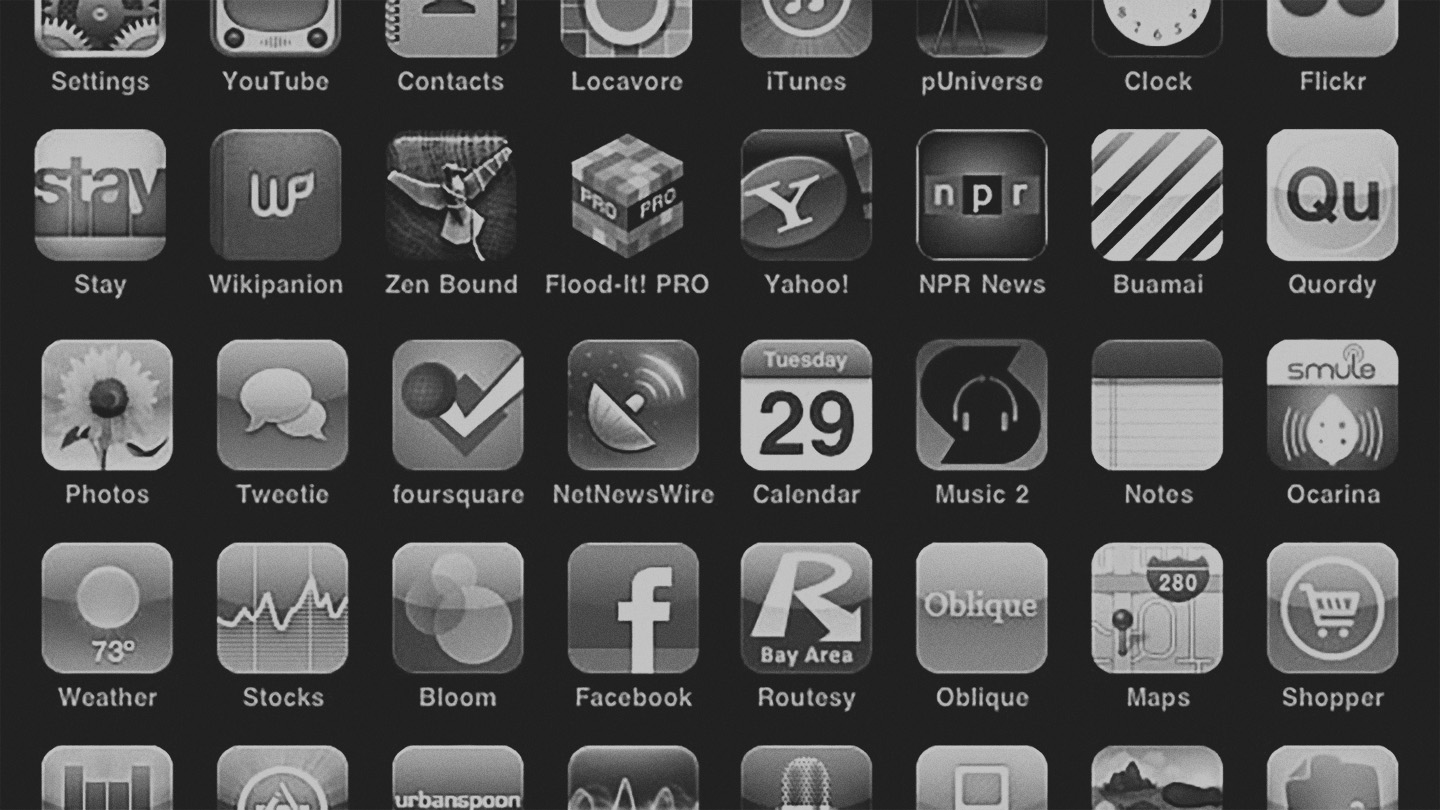
Unlike desktops, a phone would always be carried by the user, meaning that platform usage can exist in more spontaneous bursts, and applications can now demand a user’s attention at any point through notifications. Someone’s time on a desktop application is limited to the time spent physically around a desktop, but the potential screen time on a phone is endless. This new attention dynamic paired perfectly with social media, as the communication features inherent in these apps (such as comments, messages, etc.) led to increased notifications, enabling more frequent usage.
And then, in the early 2010s, the social media landscape entered a boom. Boosted connection speeds introduced by 4G-capable phones paved the way for creative video and photo-sharing concepts, which came right as smartphone ownership rates exponentially grew towards the majority. For the first time, it was viable to make online platforms with mobile being the entire focus rather than desktop computers.
Venture Capital saw the opportunity and jumped to cash in on the hype of this new-aged social media landscape, speculatively funneling more than one billion dollars per quarter in the mobile sector by 2014. The basis for most investments came from virality and user counts, hoping that a magical path towards monetization would appear at a critical mass of users or, more likely, another buyer would swoop in down the line.
This soon proved wildly unsustainable, and like the dotcom bubble, the social media landscape had to confront the wild expectations of growth it set for itself. Platforms that had their fifteen minutes of fame through hype-lensed coverage in the news struggled to maintain a user base who started to grow tired of the novelty factor from which many of these applications emerged. The most emblematic case study of this absurd boom-bust cycle was Yo.
Yo, launched in 2014 and initially made as an April Fools joke, was an app where users could only send push notifications to each other that contained no message other than “Yo.” The joke resonated with enough people that it was the subject of a slew of media coverage and topped the App Store’s charts shortly after. And by simply existing during this social media boom, investors smelled the minor virality. They gave the app more than two million dollars, valuing the joke app with no function to be worth $5-10 million. Yo shut down only a few years later.

As the dust settled, the mobile social media field shrunk to only a handful of active platforms: mainly Snapchat, Facebook, Instagram, & Twitter. At this point, however, mobile users’ focus never shifted back to the web. The convenience of mobile platforms left the original concept of the virtual space obsolete. As hyper-specific platforms lost their novelty, a new value proposition emerged, ensuring the longevity of remaining platforms and centralizing social interaction online. An application must capture as many use cases as possible to win the user-count arms race. This meant completely abandoning the utilitarian ethos of social media platforms to empower social interaction in favor of balancing media consumption and social interaction in one place.
Platforms quickly abandoned chronological content feeds for algorithmically curated ones, engineered by psychologists and addiction specialists to boost session times and encourage users to fall into content “rabbit holes.” For the first time, users had no control over their content, and these platforms transformed from social places into slot machines fueled by users’ interests and personal connections. This departure from the earlier idea of distinct virtual spaces resulted in one’s interests no longer assuming form, now forced to exist in a disposable feed in context to everything else that makes up a user’s self-perception, exploited for cheap serotonin releases.
TikTok’s vertical short-form video format dumped gasoline on the already blazing transformation of social media into pure “media.” Its single stream of algorithmically presented content, uninterrupted by any whitespace, proved to be the media consumption format that catapulted the platform to the top in downloads and average use time. Other social media platforms immediately leaped on the bandwagon, adopting the format and abandoning previous layouts more geared toward social interaction. Despite initial backlash, these platforms doubled down on their vertical video bets, which proved rewarding with record-level usage times.
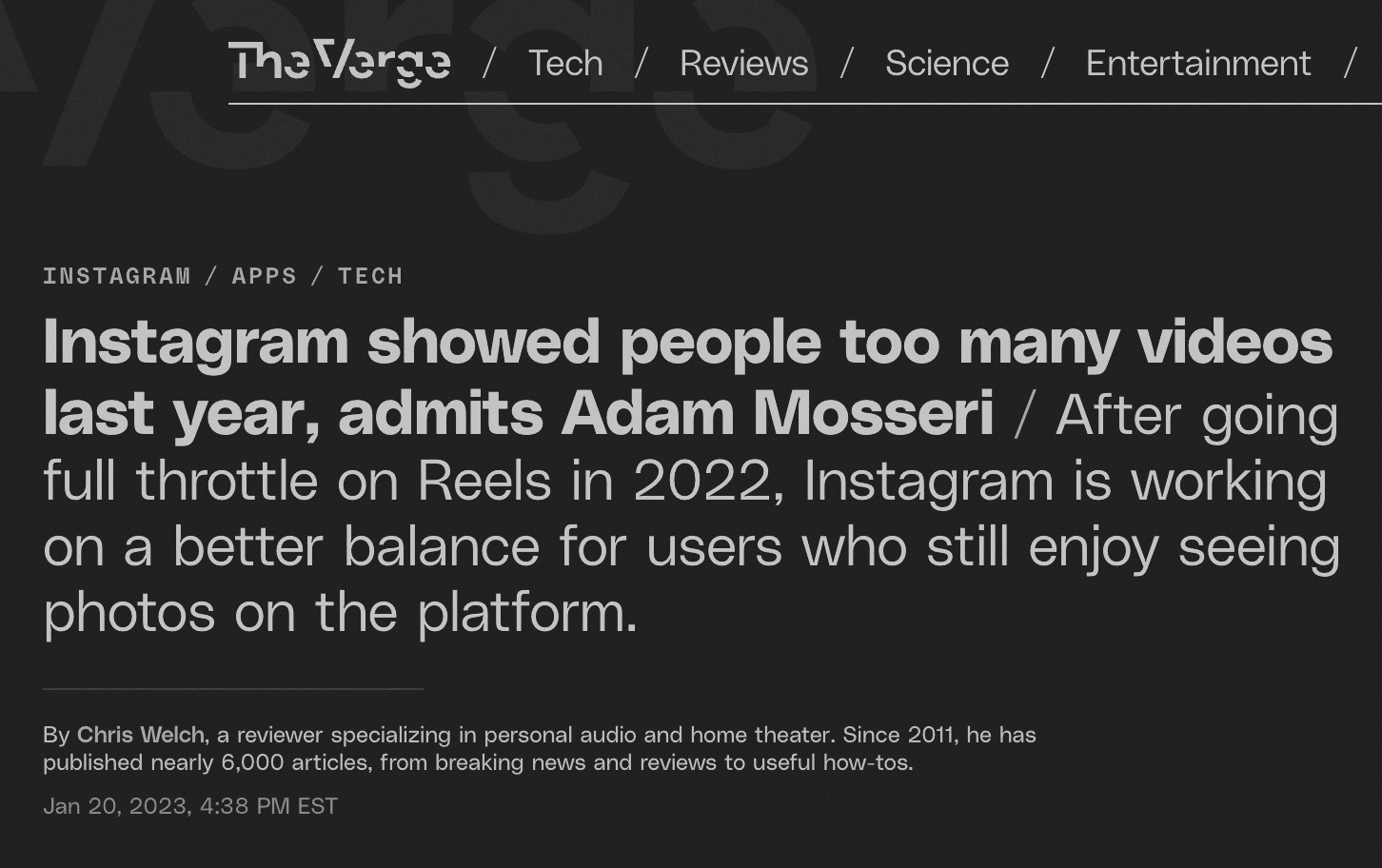
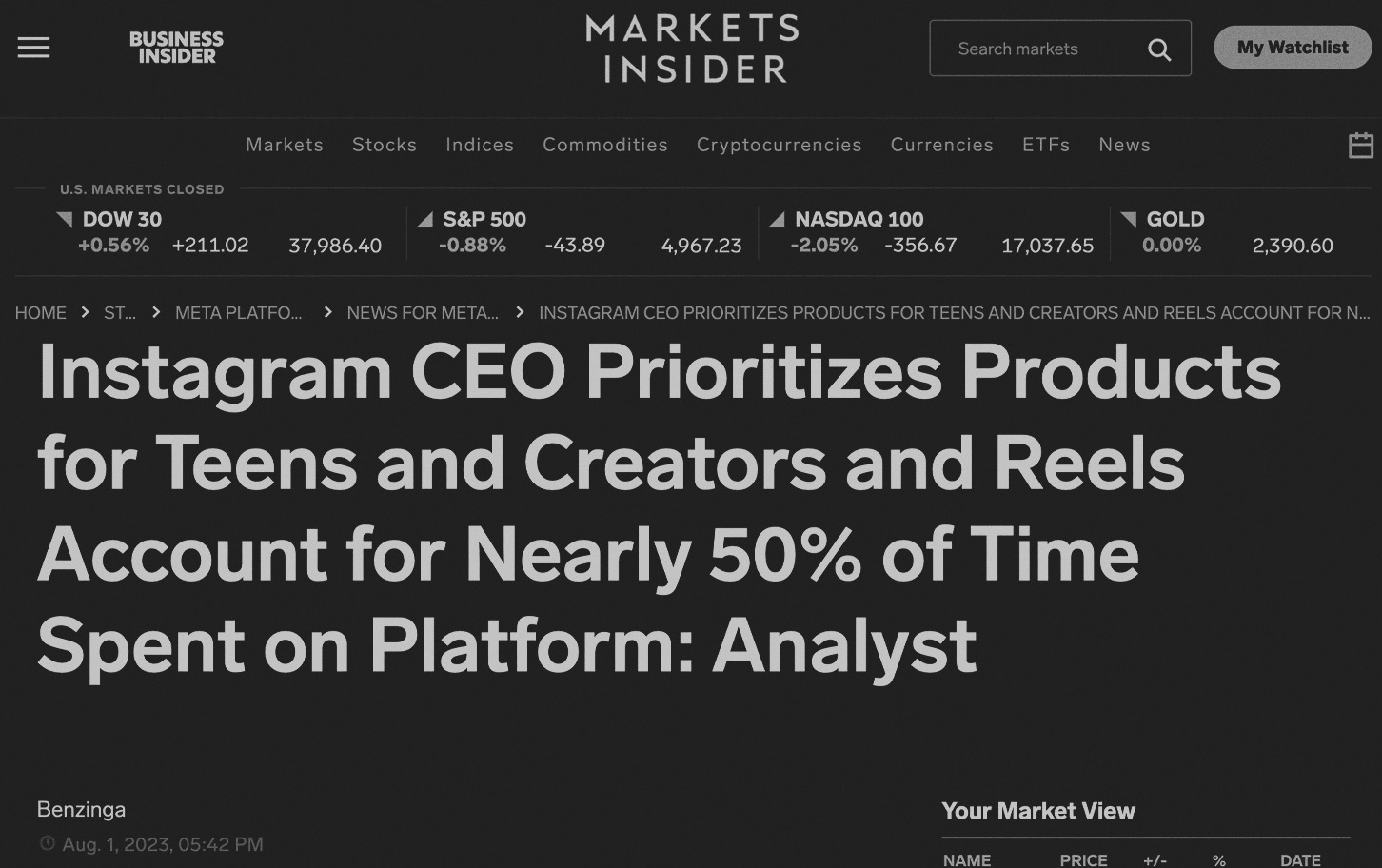
In our current vertical video world, a visit to any social media platform is not met with a focus on social futures but instead a feed of media vying for mindless consumption. The promise of convenience in centralizing interests led to the monetization of the act of interest. Investors have learned from their mistakes during the social media boom and realized that the real money in social media lies in the media aspect, leaving our interests confined to this stream of noise. The only way to break free of that noise is to redefine virtual spaces that allow unobstructed engagement and meaningful interactions with the content and communities that resonate with us.
Works Cited
- Burja, Samo. “The Centralized Internet Is Inevitable.” Palladium Magazine, 20 Oct. 2020, palladiummag.com/2020/10/19/the-centralized-internet-is-inevitable.
- Greenfield, Susan. Mind Change: How Digital Technologies Are Leaving Their Mark on Our Brains. 2014, ci.nii.ac.jp/ncid/BB17484208.
- Holt, Kris. "As internet forums die off, finding community can be harder than ever.” 27 Feb. 2020, engadget.com/2020-02-27-internet-forums-dying-off.html.
- Iyer, Ganesh, and Zsolt Katona. “Competing for Attention in Social Communication Markets.” Management Science, vol. 62, no. 8, Aug. 2016, pp. 2304–20. doi.org/10.1287/mnsc.2015.2209.
- Lahiri, Anusuya. “Instagram CEO Prioritizes Products for Teens and Creators and Reels Account for Nearly 50% of Time Spent on Platform: Analyst.” markets.businessinsider.com, 1 Aug. 2023, markets.businessinsider.com/news/stocks/instagram-ceo-prioritizes-products-for-teens-and-creators-and-reels-account-for-nearly-50-of-time-spent-on-platform-analyst-1032502812.
- Litt, Eden, et al. “What Are Meaningful Social Interactions in Today’s Media Landscape? A Cross-Cultural Survey.” Social Media + Society, vol. 6, no. 3, July 2020, p. 205630512094288. doi.org/10.1177/2056305120942888.
- Maffei, Lucas. “SurveyMonkey study finds social media apps ruled mobile in first half of 2016.” 28 July 2016, techcrunch.com/2016/07/28/surveymonkey-study-finds-social-media-apps-ruled-mobile-in-first-half-of-2016.
- “Mobile Fact Sheet.” Pew Research Center, 14 Apr. 2024, pewresearch.org/internet/fact-sheet/mobile.
- Powlson, Matt. “‘Growth First, Profits Later Social Media Model - Becoming Increasingly Creaky.’” The Guardian, 6 Aug. 2013, theguardian.com/media-network/media-network-blog/2013/aug/06/growth-profits-social-media-platforms.
- Sacasas, L. M. “The Tech Backlash We Really Need.” The New Atlantis, no. 55, 2018, pp. 35–42. jstor.org/stable/26487782.
- Shontell, Alyson. “THE INSIDE STORY OF YO: How a ‘Stupid’ App Attracted Millions of Dollars and Rocketed to the Top of the App Store.” Business Insider, 23 June 2014, businessinsider.com/the-inside-story-of-yo-there-isnt-actually-1-million-in-the-bank-2014-6.
- “U.S. Daily Time on Social Media Platforms 2023.” Statista, 26 Mar. 2024, statista.com/statistics/1301075/us-daily-time-spent-social-media-platforms.
- Welch, Chris. “Instagram Showed People Too Many Videos Last Year, Admits Adam Mosseri.” The Verge, 20 Jan. 2023, theverge.com/2023/1/20/23564321/instagram-reels-photos-adam-mosseri-too-many-videos.
- Wong, Matthew. “After Two Big Quarters, Mobile Sector Falls Below " Billion in VC in Q1.” CB Insights Research, 7 June 2017, cbinsights.com/research/mobile-venture-capital-q1-2014.
- Woolley, Kaitlin, and Marissa Sharif. “Down a Rabbit Hole: How Prior Media Consumption Shapes Subsequent Media Consumption.” Journal of Marketing Research, vol. 59, no. 3, Jan. 2022, pp. 453–71. doi.org/10.1177/00222437211055403.